Geometry for GCSE - Visual Explanations and Examples
Categories: gcse geometry
Level:
Geometry is all about understanding shapes, angles and the relationships between them. It is one of the most visual parts of GCSE Maths, with diagrams helping you discover patterns, understand mathematical rules and solve problems.
Many of these topics are also covered by videos on the YouTube channel GraphicMaths.
In this section, you can explore the properties of triangles, quadrilaterals, polygons and circles. You will learn how to calculate missing angles, recognise special relationships between lines and shapes, and use geometric rules to solve problems step by step.
Whether you are learning geometry for the first time, revising for your GCSE exams or supporting someone with their maths, these explanations and visual examples will help you build your understanding and confidence.
These are the main geometry topics, if you want to dive right in:

|
Geometry rules |
|
Parallel lines |

|
Polygons |

|
Tessellations and symmetry |

|
Circle geometry |

|
Transformations |
|
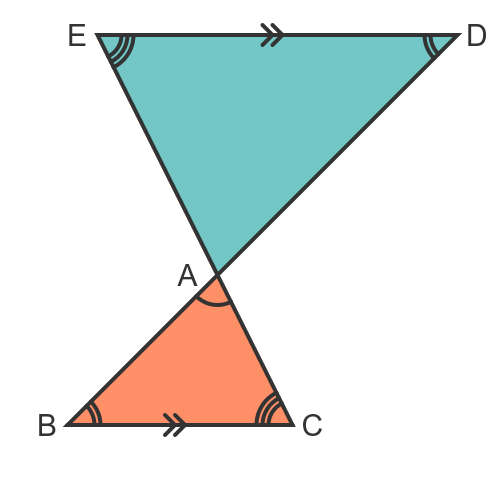
Congruent and similar shapes |

|
Area and perimeter |
If you prefer a quick overview of GCSE Geometry, read on.
Geometry Rules
Master the essential geometry rules that help you solve geometric problems.
You can solve many geometry questions by recognising a familiar pattern and applying the correct rule. In the geometry rules section, you will learn that angles on a straight line add up to 180°, angles around a point add up to 360°, and the interior angles of a triangle add up to 180°.
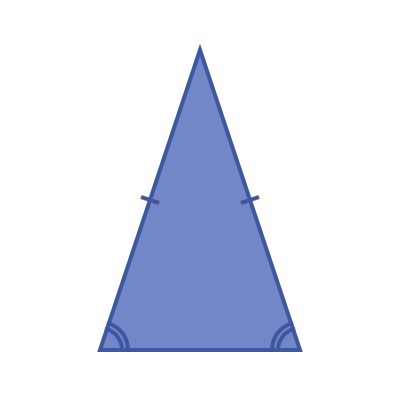
You will also explore the angle properties of quadrilaterals, exterior angles of triangles, and the relationships between the equal sides and angles of isosceles triangles.
These fundamental rules are the building blocks of geometry. Learning to recognise when and how to use them will help you work out missing angles, explain your reasoning and tackle more challenging exam questions.
Parallel Lines
Discover how parallel lines create related angles.
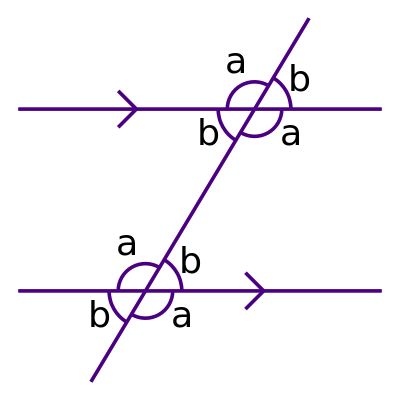
When a line crosses two parallel lines, it creates several pairs of angles that are related. Recognising these patterns allows you to calculate unknown angles in diagrams.
You will explore corresponding angles, alternate angles and co-interior angles. You will learn which angles are equal, which add up to 180°, and how to use these relationships to find missing values.
Understanding parallel lines is particularly useful in multi-step geometry questions, where you may need to combine several angle rules to reach the answer.
Polygons
Explore the many shapes you can make using straight lines.
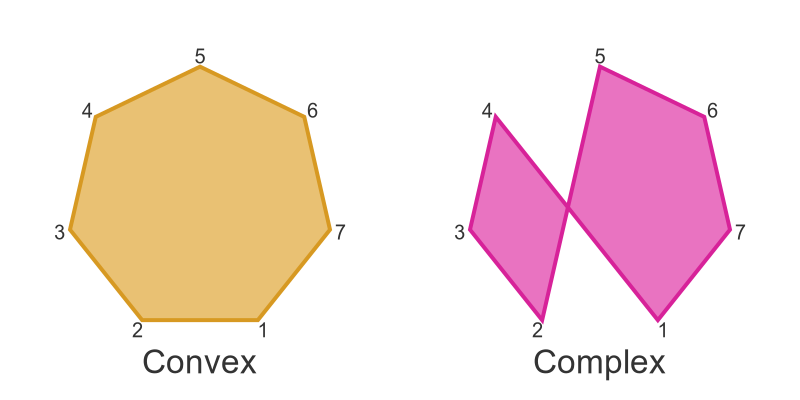
A polygon is a closed, two-dimensional shape made from straight sides. Triangles, squares, pentagons, hexagons and octagons are all examples of polygons, each with its own properties.
You will discover how polygons are classified, how to recognise their symmetries and how their sides and angles determine their shape. You will also explore the differences between regular and irregular polygons, along with patterns that appear when shapes are repeated or fitted together.
Understanding polygons helps you recognise geometric relationships, identify useful properties and solve questions involving angles, symmetry and shape.
Here are some quick links to more detailed polygons topics:

|
Regular polygons |

|
Interior and exterior angles |
|
Triangles |

|
Quadrilaterals |

|
Pentagons |

|
Hexagons |

|
Octagons |
|
Other polygons |

|
Star polygons |
Circle Geometry
Unlock the rules of circle geometry that connect angles, lines and points on a circle.
Circles have several special properties that make them an important part of GCSE Geometry. Understanding these relationships lets you calculate missing angles and solve problems that might initially seem complicated.
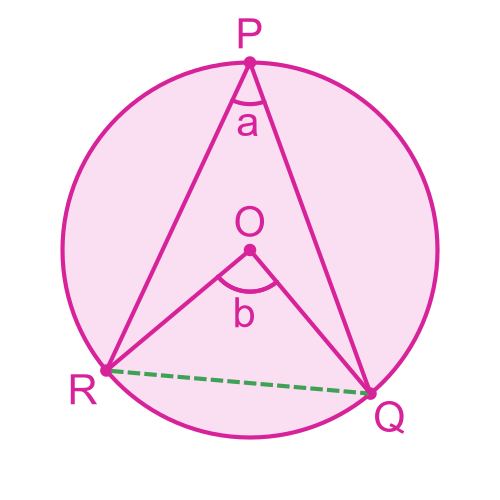
You will learn about the main parts of a circle, including the centre, radius, diameter, chord, arc, sector and tangent. You will then explore the circle theorems, which describe important relationships between angles and lengths in circle diagrams.
Circle theorem questions often require you to combine several rules. Learning to recognise the relevant features of a diagram will help you identify the right theorem and explain your reasoning clearly.
Here are some quick links to the circle geometry rules:




Transformations
Move, reflect and resize shapes while exploring what changes and what stays the same.
Transformations describe how a shape can be moved or changed on a set of axes. They provide a visual way to understand how the shapes relate to one another.
You will explore four main transformations:
- Translations: moving a shape a in a particular direction.
- Reflections: flipping a shape over a mirror line.
- Rotations: turning a shape around a fixed point, through a given angle.
- Enlargements: scaling a shape by a given factor, making it larger or smaller.
You will learn how to describe transformations accurately and recognise their effects on position, orientation and size. You will also investigate how lengths, angles and other properties behave under different transformations.
These skills are important for interpreting diagrams, working with coordinates and understanding congruent and similar shapes.
Build Your Geometry Skills with GraphicMaths
Geometry becomes much easier to understand when you can see the relationships between shapes and angles. GraphicMaths uses clear explanations, diagrams and visual examples to help you explore the ideas behind the rules.
Start with the basic angle facts if you are new to the topic, or choose a specific area to revisit as part of your GCSE revision. As your confidence grows, you can combine what you have learned to tackle more challenging geometric problems.
Explore a topic, follow the diagrams and discover the maths behind the shapes.
These resources are designed to support GCSE Maths students. They cover a range of useful mathematical topics but are not intended to provide a complete GCSE course or follow any particular exam board's specification. More...